
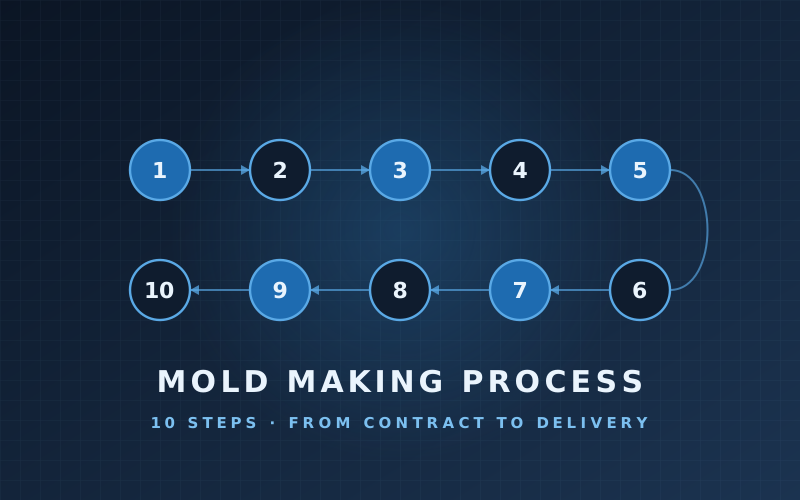
A mold starts with design and is completed through machining and testing. Let's walk through the 10 steps listed on the Production Process page of EHWA Precision Mold. The description of each step is based on the work generally done in mold making.
The 10 steps at a glance
- Contract — The product and the scope of the mold are agreed, and production begins.
- Design — The structure of the mold is designed to match the shape of the product.
- Material Purchase — Mold materials suited to the design are prepared.
- Pocket Machining — Pockets are machined into the mold plates to hold parts such as the cavity and core.
- Machining — Mold parts are machined by turning, milling, electrical discharge machining (EDM), grinding and more.
- Finishing (Hand Fitting & Polishing) — Machined surfaces are refined and fitted to finish the mold faces.
- Assembly — The machined parts are assembled into one mold.
- First Trial (T1) — The finished mold is used to mold the product for the first time.
- Modification Completed — Based on the first trial, any points that need correcting are modified.
- Delivery — The finished mold is delivered to the customer.
The machines that do the work
The following equipment is listed on our Machinery page (see the page for makers and models):
- Lathes — 800x1500, 580x1000, 460x1000
- Milling machines — two listed
- EDM machine — mid-size
- Grinding machine — mid-size
- Radial drill — 1000
In general, lathes turn round parts, milling machines cut flat faces, grooves and pockets, EDM machines produce shapes that are hard to cut with tools, grinders create precise surfaces, and radial drills handle drilling.
The first trial and modification
Even when a mold is machined exactly to its design, nobody can be sure how the product will come out until it is actually molded. That is why it is common practice to mold the product in a first trial after assembly, modify the mold based on the result, and only then deliver it. EHWA Precision Mold's 10 steps also include First Trial and Modification Completed as separate steps.
Lead time and cost depend on the product, so please leave your product details through Quote & Inquiry for a consultation.
Frequently asked questions
Q. In what order is a mold made?
In 10 steps: Contract → Design → Material Purchase → Pocket Machining → Machining → Finishing → Assembly → First Trial (T1) → Modification Completed → Delivery.
Q. What is the first trial (T1)?
It is the step in which the finished mold is used to mold the product for the first time. Based on the result, corrections are made before delivery.
Q. What equipment is used for machining?
The Machinery list on our website includes lathes, milling machines, an EDM machine, a grinding machine and a radial drill.